Posts tagged ‘mutual respect’
74. First Day Jitters by Julie Danneberg
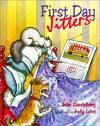 Retell: Sarah Hartwell is nervous about going to her new school. She hides under the covers while Mr. Hartwell urges her to get out of bed. Luckily the students, the principal and the staff are friendly to Sarah and she eventually feels ready for the first day of school. It’s a good thing because Sarah isn’t a kid–she’s the teacher.
Topics: first day of school, nervousness, teachers
Units of Study: Realistic Fiction,
Tribes: mutual respect, personal best, attentive listening
Habits of Mind: perseverance
Reading Skills: making connections, making predictions
Thoughts: I can’t believe tomorrow is the first day of school! I’m surprised by my own first day jitters. Last year I looped with my class. The night before the first day of school I remember feeling more relaxed because I already knew my students. Tomorrow I will be starting with a new batch of 4th grade learners. Though I’m not starting at a new school like Sarah Hartwell, I still feel anxious. I can only imagine how my students feel. I hope that after reading this book tomorrow my students will think of ways to help each other fight the first day jitters.
Welcome back to school everyone!
73. David Goes to School by David Shannon
 Retell: David is a rambunctious boy who wreaks havoc at school. After coloring on the desks he stays in after school to clean them up.
Topics: school, rules, behavior, bathroom, calling out
Units of Study: Personal Narrative
Tribes: mutual respect, attentive listening, personal best
Writing Skills: using memories to generate notebook entries
Thoughts: Here is a just-for-fun read aloud for the first day of school. It’s a great read for beginning a discussion about rules, agreements and norms. If you have access to Guys Read you may want to share David Shannon’s story about how he created the David books. The anthology has cool original pictures of the young version of his other book No, David!
72. Love You Forever by Robert Munsch
 Retell: A mother starts a tradition of singing a song to her son: “I’ll love you forever, I’ll like you for always, As long as I’m living my baby you’ll be.” Through the terrible twos, adolescence and adulthood the mother sings this song to her child. When the mother becomes old and sick, it is the son’s turn to sing the song.
Topics: family, childhood, parenting
Units of Study: Personal Narrative, Memoir
Tribes: mutual respect
Reading Skills: making connections, prediction
Writing Skills: using traditions and special moments in your life to create a story
Thoughts: I just got back from my friend’s baby shower. I’m kicking myself for not adding this book to her other gifts. This is a book that is sure to make the reader teary-eyed. If you are strong enough to read it in front of your class, it could be a great mentor text for generating ideas for personal narratives or memoirs. This book could inspire young authors to think and write about the traditions, the songs, or customs important to their own families.
70. Agatha’s Feather Bed: Not Just Another Wild Goose Story by Carmen Agra
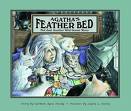 Retell: Agatha is famous for saying, “Everything comes from something.” One night, as she dreams on her new feather bed she is visited by naked geese who want their feathers back. Agatha comes up with an interesting compromise.
Topics: origins, fabric, responsibility
Units of Study: Social Issues
Tribes: mutual respect
Habits of Mind: responding with wonderment and awe, thinking flexibly
Reading Skills: monitoring for sense (understanding idioms and puns), inference
Writing Skills: using first-person narration, including puns
My Thoughts: In her author’s note Deedy writes, “What we choose to discuss with our children concerning ivory, whalebone, or the Brazilian rain forest is a matter of both individual conscience and collective responsibility. But the first step is to ask.” This book is all about inspiring people to ask, “Where does it come from?” Reading these words I’m reminded of a 4th grader who seemed so shocked when she discovered that leather is made from the hides of cows. The text contains a lot of interesting features. When describing her old mattress as ‘lumpy’ and ‘bumpy’ the letters actually look lumpy and bumpy. There are lots of cute idioms, puns and play-on-words. I know I’ll have to explain to my students why the name of the catalog (B.B. Lean) is so funny.
69. Big Al by Andrew Clements
 Retell: Big Al is one scary fish. He happens to also be the nicest fish you’ll ever meet. Unfortunately, the other fish in the sea don’t realize that. Big Al tries to make friends but the others can’t get past the way he looks. One day the little fish get caught in a net. Big Al comes to the rescue and the other fish realize what a wonderful fish he really is.
Topics: fish, friendship, respecting differences, appearances, golden rule
Units of Study: Social Issues, Talking and Writing About Texts
Tribes: mutual respect
Habits of Mind: thinking flexibly
Thoughts: It’s that time of year again. I’m exhausted from moving desks from one end of the room to the other, cleaning up after leaks under the sink (disgusting!!), and labeling hundreds of books destined to enter my classroom library. I was almost too tired to choose a read aloud today. But then my friend Katie came to my rescue and brought this read aloud which she plans to read during the first week of school. This is a wonderful book for discussing the meaning of mutual respect. Some may read this book and think, “Why did Big Al go and save the rest of the fish? They didn’t give him the time of day. They don’t deserve his help.” Even though Big Al was not being respected by the other fish, he didn’t let the fish get caught in the net. He did what was right and not only gained many friends, but taught the others a valuable lesson.
64. What a Day it Was at School! by Jack Prelutsky
 Retell: A collection of silly school poems on topics such as: homework, field trips and farting.
Topics: school, homework, field trips, libraries, food chain, history, poetry, partnerships
Units of Study: Fantasy, Authoring an Independent Reading Life
Tribes: mutual respect
Habits of Mind: responding with wonderment and awe
Writing Skills: incorporating rhythm and rhyme
My Thoughts: The poems in this collection are very, very silly–perfect for those ‘just for fun’ read alouds I mentioned yesterday. I think I’ll read, “I Made a Noise This Morning” (a poem about a student farting in class) when my students need a quick laugh. Though this collection is probably more suitable for younger grades, a few of the poems could be good hooks for mini-lessons or project launches. I’m planning on sending home more independent project ideas in Science and Writing. When I launch this project I may read Prelutsky’s “Homework” which describes a gooey experiment that didn’t go as planned. There is a cute poem entitled, “A Classmate Named Tim,” that I think I’ll use when introducing partnerships.
60. In My Momma’s Kitchen by Jerdine Nolen
 Retell: This is a heartwarming collection of small moments that all take place in a family’s kitchen: a daughter receives a music scholarship, children make up stories, women chitchat and a father makes his signature dish.
Topics: family, community, childhood
Units of Study: Personal Narrative, Memoir
Tribes: mutual respect
Reading Skills: monitoring for sense, envisionment, interpretation
Writing Skills: zooming in on small moments
My Thoughts: This is a great text to read at different points of the year. I originally purchased this book thinking it would be a good read aloud for the Personal Narrative unit. After reading it a second time, I realize that it’s also a great mentor text for the Memoir unit. Each story is connected by its setting–the kitchen. Using this text students could try out Nolen’s strategy of thinking of an important place (a room, a park) and write memories associated with that place. Since this book reads like an anthology of notebook entries, you could use this text when introducing the writer’s notebook.
58. Riding the Tiger by Eve Bunting
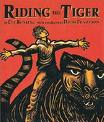 Retell: Danny, a new boy in town, is invited to ride on the back of a tiger. When he notices the fear in the eyes of passersby he tries to get off of the tiger. He soon realizes that once you get on the tiger it’s difficult to get off.
Topics: danger, choices, excitement, gangs, influence, power, respect, fear, peer pressure
Units of Study: Talking and Writing about Texts, Social Issues
Tribes: right to pass, mutual respect
Reading Skills: inference, interpretation, envisionment
Writing Skills: using dialogue, incorporating metaphors in to a story
My Thoughts: As the school year approaches I am thinking about the books that I will want to read during the first few weeks of school. During the first two weeks of school I like to read books that lend themselves well to teaching the five agreements of our school (These agreements are based on Tribes. Our school added a fifth agreement–‘personal best’) Riding the Tiger is an excellent book for teaching about the ‘right to pass’. From the beginning of the story Danny doesn’t feel comfortable accepting a ride from the tiger without first asking his mom for permission. He accepts the ride anyway and becomes increasingly more conflicted about the ride. He eventually takes the ‘right to pass’ when he finally gets off the tiger and helps a man who has fallen down. This book will certainly inspire discussion about peer pressure and gang recruitment. When introducing this book you will want to set students up to do deep interpretation work. Some students may not realize that the tiger is metaphorical.
57. The Dot by Peter H. Reynolds
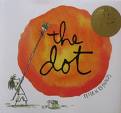
Retell: Vashti is frustrated in art class. She doesn’t have confidence in her artistic ability. Her teacher tells her to start with a dot and see where it takes her. Soon she experiments with dots of different colors, shapes and sizes and becomes pleased with the results.
Topics: art, writer’s block, creativity, experimentation
Units of Study: Personal Narrative
Tribes: personal best, appreciations/no put-downs, mutual respect
Habits of Mind: persisting, creating-imagining-innovating, responding with wonderment and awe, taking responsible risks, thinking interdependently
Writing Skills: dealing with writer’s block, revising
My Thoughts: Though this book is about art, readers will make the obvious connection to writing. I love the message of this book—experiment and enjoy the process. If I don’t read this out loud to my entire class, I will definitely use this in small group work to help struggling writers get over their fear of the blank page. I like how at the end of the book Vashti helps another young artist get over his frustration. It’s a good example of how learners help one another.
56. What Joe Saw by Anna Grossnickle Hines
 Retell: Joe is always lagging behind the class. His teacher and his classmates are always telling him to hurry up. It’s not until a classmate stops to tie his shoes that he realizes why Joe keeps falling behind.
Topics: school, field trips, discovery, curiosity
Units of Study: Realistic Fiction, Talking and Writing about Texts
Tribes: appreciations/no put-downs, mutual respect
Habits of Mind: responding with wonderment and awe
Reading Skills: interpretation, inference
Writing Skills: using repetition, dialogue
My Thoughts: The main character in this book reminds me of my sweetheart. When we’re on route somewhere he always stops to smell the flowers on butterfly bushes or picks fruit from trees. If I’m in a hurry it can be frustrating at first, but most of the time it’s worth it to be a few minutes late. I appreciate how he makes me slow down and notice the world around me. What Joe Saw is a good book to read when you want your class to discuss the importance of paying attention to small details. However, you may not want to read this book to your class just before going on a field trip. It may be good to read during an interpretation unit. I can imagine having interesting discussions about the individual vs. the group.
 Teachable Texts