Posts tagged ‘making connections’
10. Come On, Rain! by Karen Hesse
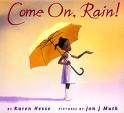 Retell: A young girl anticipates the long awaited thunderstorms that will cool down the humid city she lives in.
Topics: heat, rain, family, summer, cities, thunderstorms
Units of Study: personal narrative, poetry
Reading Skills: envisionment, making connections
Writing Skills: including similes, using active verbs, personification, alliteration
My Thoughts: This book makes me wish it was more humid outside right now. Every New Yorker without air conditioning will be able to relate to this book. I love how Hesse uses poetic devices throughout this small moment story, making it a nice mentor text for personal narrative or poetry unit. She includes personification: “The smell of hot tar and garbage bullies the air…” There is alliteration and assonance: “The first drops plop down big, making dust dance all around us.” Hesse teaches young writers to slow down and zoom in on ordinary moments.
8. The Lucky Star by Judy Young
 Retell: Ruth, a young girl growing up during The Great Depression, discovers that her school will be closed down before she enters her 5th grade year. Ruth learns a lesson of perseverance and counting one’s lucky stars.
Topics: The Great Depression, perseverance, family,
Unit of Study: Historical Fiction, Character
Tribes: Personal best
Reading Skills: inference, making connections, prediction
Writing Skills: incorporating setting details, using sensory details
My Thoughts: This book would be a great mentor text during a unit on reading and writing historical fiction. However, I’m tempted to use this at the beginning of the year when I introduce partner work and independence. The Lucky Star teaches that smart people persevere through difficult situations. A closure of a school, or similarly an absence of a teacher or a change in schedule, does not mean that learning stops completely.
7. Guys Write for Guys Read
 Retell: Jon Scieszka edits this fabulous collection of stories, comics, essays, illustrations and vignettes contributed by prominent male authors and illustrators. Contributors include: Stephen King, Matt Groening, Jerry Spinelli, Seymour Simon, James Howe, Neil Gaiman, Gary Paulsen and many more. Royalties from the book are used to support Scieszka’s Guys Read Program.
Topics: boys, family, growing up, reading, writing, art
Units of Study: Personal Narrative, Launching the Reading and Writing Workshop, Character, Personal Essay, Content-Area Reading and Writing, Nonfiction, Memoir, Social Issues, Fantasy, Preparing for the ELA
Tribes: Mutual Respect, Personal Best, Appreciations/No Putdowns, Right to Pass
Reading Skills: inference, making connections, interpretation
Writing Skills: writing with voice, zooming in on a small moment, observing the world for stories
My Thoughts: This book is teacher gold! Guys Write for Guys Read has a plethora of short stories that can be used for mentor texts in almost every Reading and Writing unit. One of the stories, “Reading Can Be Dangerous” by Tedd Arnold was featured on the 5th grade ELA test last year. James Howe, author of Bunnicula, writes a personal narrative about getting help from a friend on how to be a boy–a great text for personal essay or discussing gender issues. Many authors write about how they came to love reading and writing. Christopher Paolini, author of Eragon, writes about how he fell in love with fantasy–great to read when you launch a unit on Fantasy reading and writing. Patrick Jones, a librarian, writes about how being interested in wrestling inspired him to become a voracious reader. Many entries include samples of famous authors childhood work alongside their adult work. For example, Dav Pilkey, author/illustrator of the infamous Captain Underpants series, writes about a comic strip he started when he was 11. I will probably use this book for almost every unit I teach this year.
If you don’t pick up a copy of this book you must go to Scieska’s website, Guys Read. The site is dedicated to inspiring more young boys to fall in love with reading. Mr. Scieszka, you’re my hero.
5. The Girl Who Lost Her Smile by Karim Alrawi
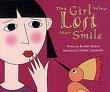 Retell: One day in Baghdad a girl named Jehan loses her smile. Her father searches the world for someone who will help his daughter find her smile.
Topics: Baghdad, art, folk tales
Units of Study: Fantasy, Creating Community, Geography
Tribes: Personal Best, Mutual Respect
Reading Skills: envisionment, making connections, prediction
My Thoughts: This is a very quick read aloud which could be good for discussing the expectation of doing one’s personal best and the satisfaction it brings. Throughout the book Jehan’s father brings her the most beautiful art in the world to cheer her up. However, it is not until she participates in the arduous process of making a wall gleam that she finally finds her smile. It woule be nice to use this as a community building mentor text. We can discuss how Jehan’s family did their best to cheer her up and how we should try and give our friends encouragement and help them find their smiles when they are down. Her father brings art from around the world to cheer her up. I could see asking students to find those places on a world map to practice their geography skills.
4. Neeny Coming, Neeny Going by Karen English
 Retell: Neeny and her cousin were raised on Daufuskie Island, located off the coast of South Carolina. Years before, Neeny went back to the mainland to live with her mother. When Neeny returns to the island, her cousin realizes that Neeny is not the same cousin she grew up with.
Topics: change, family, environmental issues
Units of Study: Social Issues, Character
Tribes: mutual respect
Reading Skills: envisionment, prediction, inference, monitoring for sense, interpretation, making connections
Writing Skills: writing with voice
My Thoughts: This is a great book for the Social Issues unit. I can imagine a juicy discussion about how much the mainland changed Neeny. Many of my students travel back to their home countries during vacation. I think they could make a lot of connections to this book. I can see using this book as a mentor text for showing how authors write with a distinctive voice.
2. Three Days on a River In a Red Canoe by Vera B. Williams
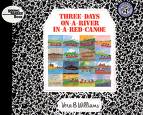
Retell: After purchasing a red canoe at a yard sale, a family goes on a three-day canoe trip.
Topics: Family, adventure, camping
Units of Study: Personal Narratives, Launching the Writers Notebook
Tribes: Personal Best
Reading Skills: envisionment, making connections, inference
Writing Skills: incorporating details about setting, using transition words, including sensory details, writing endings that connect to the beginning
My thoughts: This book has great teaching potential. As the marbled cover suggests it reads like someone’s writers notebook. Each page describes a scene from the camping trip. I can imagine using this book when I introduce writers notebooks to my students. Each page is a small moment that could be stretched into a larger story. The colorful, colored pencil drawings will be inspiring for young artists who like to draw pictures with each notebook entry. I plan on using this as a mentor text for students who want to write endings that connect to an earlier scene.
 Teachable Texts