Posts tagged ‘interpretation’
66. Amazing Grace by Mary Hoffman
 Retell: Grace loves to act. When her school puts on a production of Peter Pan she is eager to audition. Her classmates tell her that she can’t be Peter Pan because she is a girl and she’s black. After an inspiring visit to the ballet Grace finds confidence to audition.
Topics: reading, stories, acting, school, gender issues, racism, role models, theater, ballet
Units of Study: Social Issues, Realistic Fiction, Character
Tribes: Personal Best
Habits of Mind: persistence, striving for accuracy, thinking interdependently
Reading Skills: inference, interpretation
My Thoughts: Amazing Grace has been a favorite read aloud of mine for introducing the Social Issues unit. However, I’m thinking of reading it earlier this year when introducing the Habit of Mind–‘persistence’. Grace is a good example of how one persists when they have a dream. Grace’s dream is to play Peter Pan. Despite the discouragement she receives from a few of her classmates, Grace practices over the weekend and ends up getting the part. However, it’s interesting to note that this persistence didn’t just come from herself–she had to be encouraged by her family. I wonder if Grace would have succeeded if her Nana hadn’t taken her to the ballet.
65. Mirette on the High Wire by Emily Arnold McCully
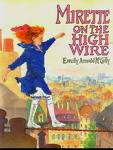 Retell: Mirette works at her mother’s boarding house. When a mysterious stranger asks for a room and takes his meals alone, Mirette is intrigued. One day she discovers the stranger walking across the clothesline. The stranger turns out to be the great Bellini, a famous tightrope walker. Mirette falls in love with the high wire and is determined to walk high above a crowd.
Topics: artists, dreams, Paris
Units of Study: Realistic Fiction, Historical Fiction
Tribes: personal best
Habits of Mind: persistence, striving for accuracy
Reading Skills: interpretation, prediction
Writing Skills: incorporating diaglogue
My Thoughts: Though this book is not a true story, the tightrope walker is based on a real person–a daredevil named Blondin who walked over Niagara Falls on a high wire. I like it when authors describe their inspiration in the author’s note. I plan on using this book when we focus on the Habits of Mind ‘persistence’ and ‘ striving for accuracy.’ The author shows the main character making a lot of mistakes and having someone fine tune her every movement.
60. In My Momma’s Kitchen by Jerdine Nolen
 Retell: This is a heartwarming collection of small moments that all take place in a family’s kitchen: a daughter receives a music scholarship, children make up stories, women chitchat and a father makes his signature dish.
Topics: family, community, childhood
Units of Study: Personal Narrative, Memoir
Tribes: mutual respect
Reading Skills: monitoring for sense, envisionment, interpretation
Writing Skills: zooming in on small moments
My Thoughts: This is a great text to read at different points of the year. I originally purchased this book thinking it would be a good read aloud for the Personal Narrative unit. After reading it a second time, I realize that it’s also a great mentor text for the Memoir unit. Each story is connected by its setting–the kitchen. Using this text students could try out Nolen’s strategy of thinking of an important place (a room, a park) and write memories associated with that place. Since this book reads like an anthology of notebook entries, you could use this text when introducing the writer’s notebook.
58. Riding the Tiger by Eve Bunting
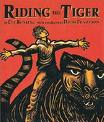 Retell: Danny, a new boy in town, is invited to ride on the back of a tiger. When he notices the fear in the eyes of passersby he tries to get off of the tiger. He soon realizes that once you get on the tiger it’s difficult to get off.
Topics: danger, choices, excitement, gangs, influence, power, respect, fear, peer pressure
Units of Study: Talking and Writing about Texts, Social Issues
Tribes: right to pass, mutual respect
Reading Skills: inference, interpretation, envisionment
Writing Skills: using dialogue, incorporating metaphors in to a story
My Thoughts: As the school year approaches I am thinking about the books that I will want to read during the first few weeks of school. During the first two weeks of school I like to read books that lend themselves well to teaching the five agreements of our school (These agreements are based on Tribes. Our school added a fifth agreement–‘personal best’) Riding the Tiger is an excellent book for teaching about the ‘right to pass’. From the beginning of the story Danny doesn’t feel comfortable accepting a ride from the tiger without first asking his mom for permission. He accepts the ride anyway and becomes increasingly more conflicted about the ride. He eventually takes the ‘right to pass’ when he finally gets off the tiger and helps a man who has fallen down. This book will certainly inspire discussion about peer pressure and gang recruitment. When introducing this book you will want to set students up to do deep interpretation work. Some students may not realize that the tiger is metaphorical.
56. What Joe Saw by Anna Grossnickle Hines
 Retell: Joe is always lagging behind the class. His teacher and his classmates are always telling him to hurry up. It’s not until a classmate stops to tie his shoes that he realizes why Joe keeps falling behind.
Topics: school, field trips, discovery, curiosity
Units of Study: Realistic Fiction, Talking and Writing about Texts
Tribes: appreciations/no put-downs, mutual respect
Habits of Mind: responding with wonderment and awe
Reading Skills: interpretation, inference
Writing Skills: using repetition, dialogue
My Thoughts: The main character in this book reminds me of my sweetheart. When we’re on route somewhere he always stops to smell the flowers on butterfly bushes or picks fruit from trees. If I’m in a hurry it can be frustrating at first, but most of the time it’s worth it to be a few minutes late. I appreciate how he makes me slow down and notice the world around me. What Joe Saw is a good book to read when you want your class to discuss the importance of paying attention to small details. However, you may not want to read this book to your class just before going on a field trip. It may be good to read during an interpretation unit. I can imagine having interesting discussions about the individual vs. the group.
54. Two Bobbies: A True Story of Hurricane Katrina, Friendship, and Survival by Kirby Larson and Mary Nethery
 Retell: This is the true story of how a stranded cat and dog survived the aftermath of Hurricane Katrina.
Topics: pets, Hurricane Katrina, survival, friendship, family, homelessness
Units of Study: Social Issues, Nonfiction, Talking and Writing about Texts
Tribes: personal best, mutual respect
Habits of Mind: taking responsible risks, thinking flexibly
Reading Skills: envisionment, inference, interpretation
My Thoughts: This is a book that I didn’t mind buying brand new and in hardcover. I found this in a bookstore in Ashland, Oregon. The cashier and I spent a few moments cooing over her ridiculously cute it is. In addition to being an amazingly touching story it’s a great text to read to learn about Hurricane Katrina. It could also be a great read aloud during an interpretation unit. On one level it’s a story about survival but it could also be interpreted as a story about friendship between two individuals who come from groups who are normally not friendly to each other.
49. Fireflies in the Dark: The Story of Friedl Dicker-Brandeis and the Children of Terezin by Susan Goldman Rubin
 Retell: Learn about the amazing life of Friedl Dicker-Brandeis, who taught art to children in the Terezin Camp during the Holocaust. The book includes several photos, drawings, paintings and writings from her students, many of whom did not survive.
Topics: art, holocaust, ghetto, Terezin, Nazis, school, poetry, drama, resiliency
Units of Study: Personal Narrative, Nonfiction, Content Area Reading and Writing, Social Issues
Tribes: personal best, mutual respect
Habits of Mind: persisting, thinking flexibly, creating-imagining-innovating, thinking interdependently, remaining open to continuous learning
Reading Skills: envisionment, determining importance, interpretation, inference
Writing Skills: launching writers notebook, zooming in on small moments
My Thoughts: One can learn many lessons from this book. I am impressed by Dicker-Brandeis’ devotion to learning. When she discovered that she would be sent to Terezin she chose not to bring items for herself, but art supplies for the children she knew would be in the camp. Through art her students were able to both escape and record the horrors around them. Though I don’t plan on teaching a unit about the Holocaust this year, I may choose to read a portion of this book when emphasizing how writers notebooks can be powerful places to record our memories, our thoughts and our struggles. It is important for our students to realize that their experiences, just like those recorded at Terezin, are important and should be recorded.
48. The Paper Bag Princess by Robert Munsch
 Retell: After a fire-breathing dragon destroys her castle, Elizabeth dons a paper bag and goes off to rescue the ‘charming’ Prince Ronald. Through cunning wit she tricks the dragon and frees the prince only to realize that perhaps he wasn’t worth saving after all.
Topics: fairy tales, dragons, princesses, princes
Units of Study: Fantasy, Social Issues, Talking and Writing About Texts
Tribes: personal best, mutual respect
Habits of Mind: persisting, managing impulsivity, thinking flexibly, striving for accuracy
Reading Skills: interpretation, inference
Writing Skills: writing interesting dialogue
My Thoughts: This is a TC read aloud classic that I have seen used in several workshops on planning effective interactive read alouds. For such a short book, there are many ways you could teach with it. It’s a great book for discussing gender issues during the Social Issues unit. After rereading this book for the 20th time I just realized what a great text it is for teaching the Habits of Mind. Elizabeth uses a lot of them! For example, her entire castle burns down but she persists and goes to save Prince Ronald. She has no clothes but thinks flexibly and fashions a dress out of a paper bag. After competely exhausting the dragon she strives for accuracy and manages impulsivity by checking to make sure the dragon is truly knocked out.
47. The House That Crack Built by Clark Taylor
 Retell: A serious poem, told in cumulative verse, detailing the many lives affected by crack.
Topics: crack, drug abuse, responsibility
Units of Study: Social Issues
Tribes: right to pass
Reading Skills: interpretation, inference, questioning, making connections
Writing Skills: using rhythm and rhyme
My Thoughts: This is an intense book. I’m trying to decide if I will read it aloud to my students this year or not. On one hand I think it’s important to have realistic discussions about drugs with elementary school students, but on the other hand I have to be aware that this book may be too heavy for some students. If I do decide to read it aloud this year I think it could be a great for the Social Issues unit. Chronicle Books has a great reading guide for the book which provides questions appropriate for both elementary and middle school aged children.
45. A Bad Case of Stripes by David Shannon
 Retell: Camilla Cream is very worried about what other people think of her. She loves to each lima beans but would never admit that to anyone at school. One day she wakes up covered in stripes. No doctor can cure her, people make fun of her and the media is obsessed with her. In the end her condition improves when she learns to be herself.
Topics: teasing, fitting in, self confidence, first day of school
Units of Study: Talking and Writing About Texts, Character, Social Issues
Tribes: right to pass, mutual respect
Habits of Mind: persisting
Reading Skills: interpretation, synthesis
My Thoughts: A Bad Case of Stripes is a great book for encouraging discussion about the importance of individuality. I think it may also be a good text for modeling how important it is to pay attention to details that may seem small but are actually really important. For example, if the reader passed over the part about Camilla liking lima beans, the ending of the book could be confusing. If you are teaching the Habits of Mind, you could ask students to pay attention to how the doctors and specialists ‘persisted’ when trying to solve the problem.
 Teachable Texts