Posts tagged ‘inference’
89. Mrs. Morgan’s Lawn by Barney Saltzberg
 Retell: Mrs. Morgan does not tolerate anyone or anything treading on her lawn. Whenever a ball lands on her lawn she confiscates it and it is never seen again. After some encouragement from his parents, Mrs. Morgan’s neighbor decides to confront her and ask for his ball back. Even when he asks her nicely Mrs. Morgan refuses to return his ball. After a few weeks he notices that Mrs. Morgan’s lawn is looking unkempt. He rakes up leaves for her and discovers that kindness can often change people’s minds.
Topics: kindness, problem-solving
Units of Study: Character, Talking and Writing About Texts
Tribes: mutual respect
Habits of Mind: taking responsible risks
Reading Skills: inference, interpretation
My Thoughts: I like to read this story when students start having conflicts with each other. Giving “I-Messages” solves many of these conflicts but sometimes something more is needed to solve a problem. Creating peace often starts by attempting to understand the person you have a conflict with. In this story, the neighbor changes from thinking Mrs. Morgan is mean to understanding how she feels about her lawn and eventually helps her, despite the fact that she has not been kind in return. When I read this out loud to my class last year, a student pointed out that “sometimes bullies act mean because they don’t feel that people are nice to them.” She was talking about a particular bully in the class who had been absent during the read aloud. She suggested to the class that they should say nice things to the student and compliment him when he did something well.
84. Chicken Sunday by Patricia Polacco
 Retell: Easter is around the corner and Miss Eula wants a new hat to wear to church. Her grandchildren and her young neighbor decide to ask Mr. Kodinski if they could work at his hat shop to earn extra money. On the way to his shop, he mistakes the children for vandals. They come up with an interesting way to earn back his trust as well as earn enough money for a new hat.
Topics: reputation, hats, chutzpah, Easter, vandalism, gifts, Holocaust survivors
Units of Study: Personal Narrative, Memoir, Social Issues, Talking and Writing About Texts
Tribes: mutual respect, personal best
Habits of Mind: thinking flexibly, creating-imagining-innovating, persisting
Reading Skills: questioning, inference
Writing Skills: zooming in on small moments, repeating powerful lines
My Thoughts: If you follow this blog daily, you’re sick of seeing entries about Patricia Polacco. I can’t help it. I love her work. Since I’m currently in the Personal Narrative mindset, her work naturally comes to mind. The illustrations in this book can be powerful teaching tools. Throughout Chicken Sunday, real photographs appear in the background. This shows that Polacco thinks about significant people in her life and then writes stories about them. I love how Mr. Kodinski’s story can be inferred through the illustrations. Previously, Miss Eula alluded to the fact that he wanted a peaceful life after suffering so much. The text never states specifically why he had a difficult life. The illustrations give you the information. Tattooed on Mr. Kodinski’s arm are six blue numbers, revealing that he survived the concentration camps. This book shows students how readers can reread a text and peal a different layer of meaning with each reading.
81. The Tequila Worm by Viola Canales
 Retell: Sophia is an intelligent, hardworking girl from McAllen, Texas. When she receives a scholarship for a boarding school 400 miles, she must learn to live in two different worlds. She longs to explore and be accepted by the people at St. Lukes, but she also wishes to be a good comadre and participate in her family’s traditions.
Topics: overcrowding, barrios, family, traditions, Mexican-Americans, friendship, ambition, choices, siblings, Day of the Dead, boarding school, scholarships
Units of Study: Social Issues, Character, Talking and Writing About Texts, Realistic Fiction
Tribes: appreciations/no put-downs
Habits of Mind: thinking flexibly, thinking interdependently
Reading Skills: inference, synthesis, interpretation, envisionment
Writing Skills: bringing out the heart of a story
Thoughts: Though I believe this book is probably most appropriate for middle school students, I wouldn’t hesitate reading sections of this book to my fourth graders. There are great examples of how writers collect stories from their lives and how people become the change they want see in the world. I love Canales’ description of the various rituals and traditions of Sofia’s family. The relationship between Sofia and Berta is interesting. They made very different choices. Sofia chose to move far away and attend college. Berta married young, stayed in her hometown and had two children. Readers could have an interesting discussion about the pros and cons of both characters’ choices.
75. 14 Cows For America by Carmen Agra Deedy
 Retell: To the Maasai people the cow is life. In June 2002 Wilson Kimeli Naiyomah returned to his Kenyan village with a tragic story from New York. Kimeli presented a cow for blessing, in honor of those who died during the attacks of September 11th. 13 others offered their own cows for blessing. The cows remain in Kenya but they continue to be a symbol of hope and compassion to people around the world.
Topics: September 11th, Maasai, Kenya, compassion, cows, hope
Units of Study: Character, Social Issues, Talking and Writing About Texts
Tribes: mutual respect
Reading Skills: envisionment, inference, monitoring for sense
Thoughts: The tone of my classroom during this short first week of school has been so positive. Students are making new friends, and seem excited about school. I now approach planning my read aloud for the third day of school which happens to also be September 11th. It feels weird to start a discussion about tragedy and terrorism on the third day of school. I don’t want to spend a lot of time discussing frightening details of that day but on the other hand I don’t want to ignore the day altogether. I’ve decided to read 14 Cows For America because it focuses more on the idea of compassion rather than tragedy. I’m hoping that the last line of the book will prompt an interesting discussion: “Because there is no nation so powerful it cannot be wounded, nor a people so small they cannot offer mighty comfort.”
Thanks Beth for recommending this fabulous read aloud!
70. Agatha’s Feather Bed: Not Just Another Wild Goose Story by Carmen Agra
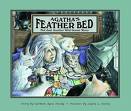 Retell: Agatha is famous for saying, “Everything comes from something.” One night, as she dreams on her new feather bed she is visited by naked geese who want their feathers back. Agatha comes up with an interesting compromise.
Topics: origins, fabric, responsibility
Units of Study: Social Issues
Tribes: mutual respect
Habits of Mind: responding with wonderment and awe, thinking flexibly
Reading Skills: monitoring for sense (understanding idioms and puns), inference
Writing Skills: using first-person narration, including puns
My Thoughts: In her author’s note Deedy writes, “What we choose to discuss with our children concerning ivory, whalebone, or the Brazilian rain forest is a matter of both individual conscience and collective responsibility. But the first step is to ask.” This book is all about inspiring people to ask, “Where does it come from?” Reading these words I’m reminded of a 4th grader who seemed so shocked when she discovered that leather is made from the hides of cows. The text contains a lot of interesting features. When describing her old mattress as ‘lumpy’ and ‘bumpy’ the letters actually look lumpy and bumpy. There are lots of cute idioms, puns and play-on-words. I know I’ll have to explain to my students why the name of the catalog (B.B. Lean) is so funny.
67. Love That Dog by Sharon Creech
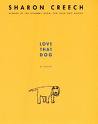 Retell: “I don’t want to because boys don’t write poetry. Girls do.” Jack reluctantly keeps a poetry journal. With encouragement from his teacher he begins to write about his dog. By using famous poems as mentor texts, Jack learns to be a prolific poet.
Topics: poetry, school, pets, loss, writer’s block
Units of Study: Independent Writing Projects, Poetry, Social Issues, Character
Tribes: personal best
Habits of Mind: striving for accuracy, thinking interdependently, thinking flexibly
Reading Skills: inference, interpretation, making connections
Writing Skills: using mentor texts to improve writing
My Thoughts: This is one of my favorite books by Sharon Creech. She captures the voice of a young writer so well. I consider this a read aloud though I often use it as a text for doing shared reading. Since each entry is dated, one could conceivably read the pages on or close to the dates in the book–a read aloud that lasts all year long. In the back of the book are poems by: Walter Dean Meyers, William Carlos Williams, Robert Frost and Valerie Worth. You could use the poems for shared reading at the same time you read the book aloud.
66. Amazing Grace by Mary Hoffman
 Retell: Grace loves to act. When her school puts on a production of Peter Pan she is eager to audition. Her classmates tell her that she can’t be Peter Pan because she is a girl and she’s black. After an inspiring visit to the ballet Grace finds confidence to audition.
Topics: reading, stories, acting, school, gender issues, racism, role models, theater, ballet
Units of Study: Social Issues, Realistic Fiction, Character
Tribes: Personal Best
Habits of Mind: persistence, striving for accuracy, thinking interdependently
Reading Skills: inference, interpretation
My Thoughts: Amazing Grace has been a favorite read aloud of mine for introducing the Social Issues unit. However, I’m thinking of reading it earlier this year when introducing the Habit of Mind–‘persistence’. Grace is a good example of how one persists when they have a dream. Grace’s dream is to play Peter Pan. Despite the discouragement she receives from a few of her classmates, Grace practices over the weekend and ends up getting the part. However, it’s interesting to note that this persistence didn’t just come from herself–she had to be encouraged by her family. I wonder if Grace would have succeeded if her Nana hadn’t taken her to the ballet.
61. The Relatives Came by Cynthia Rylant
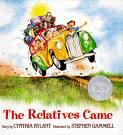 Retell: Every summer the relatives from Virginia drive several hours to visit their family. There is a lot of hugging, a lot of chatting and a lot of eating. When they leave, the house feels a bit empty.
Topics: family, summer, reunions
Units of Study: Personal Narrative, Memoir
Reading Skills: envisionment, inference, making connections
Writing Skills: using sensory details, describing how time passes
My Thoughts: I found this classic for only $2 at a great used bookstore in Mt. Shasta, California. It used to belong to a library so the bottom of each page is cracked, crinkled and reinforced with tape–a testament to how much we love this book. This is a wonderful book to use during the Personal Narrative unit. Though it’s not technically a small moment (the book spans over two weeks) sections of it can be used as a mentor text. I notice that many of my students struggle when writing about time. They often spend a lot of energy including each detail because it happened ‘next’. I see a lot of stories where each sentence begins with ‘then’. Sections of The Relatives Came could be used to show how authors deal with time. The relatives drive for a long time but Rylant doesn’t describe every single thing they see or every pit stop they make. She chooses to focus on a few details only, the strange houses, mountains, and their thoughts of purple grapes back home. The illustrations also tell a story themselves making it a good book for modeling inference.
58. Riding the Tiger by Eve Bunting
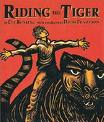 Retell: Danny, a new boy in town, is invited to ride on the back of a tiger. When he notices the fear in the eyes of passersby he tries to get off of the tiger. He soon realizes that once you get on the tiger it’s difficult to get off.
Topics: danger, choices, excitement, gangs, influence, power, respect, fear, peer pressure
Units of Study: Talking and Writing about Texts, Social Issues
Tribes: right to pass, mutual respect
Reading Skills: inference, interpretation, envisionment
Writing Skills: using dialogue, incorporating metaphors in to a story
My Thoughts: As the school year approaches I am thinking about the books that I will want to read during the first few weeks of school. During the first two weeks of school I like to read books that lend themselves well to teaching the five agreements of our school (These agreements are based on Tribes. Our school added a fifth agreement–‘personal best’) Riding the Tiger is an excellent book for teaching about the ‘right to pass’. From the beginning of the story Danny doesn’t feel comfortable accepting a ride from the tiger without first asking his mom for permission. He accepts the ride anyway and becomes increasingly more conflicted about the ride. He eventually takes the ‘right to pass’ when he finally gets off the tiger and helps a man who has fallen down. This book will certainly inspire discussion about peer pressure and gang recruitment. When introducing this book you will want to set students up to do deep interpretation work. Some students may not realize that the tiger is metaphorical.
56. What Joe Saw by Anna Grossnickle Hines
 Retell: Joe is always lagging behind the class. His teacher and his classmates are always telling him to hurry up. It’s not until a classmate stops to tie his shoes that he realizes why Joe keeps falling behind.
Topics: school, field trips, discovery, curiosity
Units of Study: Realistic Fiction, Talking and Writing about Texts
Tribes: appreciations/no put-downs, mutual respect
Habits of Mind: responding with wonderment and awe
Reading Skills: interpretation, inference
Writing Skills: using repetition, dialogue
My Thoughts: The main character in this book reminds me of my sweetheart. When we’re on route somewhere he always stops to smell the flowers on butterfly bushes or picks fruit from trees. If I’m in a hurry it can be frustrating at first, but most of the time it’s worth it to be a few minutes late. I appreciate how he makes me slow down and notice the world around me. What Joe Saw is a good book to read when you want your class to discuss the importance of paying attention to small details. However, you may not want to read this book to your class just before going on a field trip. It may be good to read during an interpretation unit. I can imagine having interesting discussions about the individual vs. the group.
 Teachable Texts