Posts tagged ‘envisionment’
49. Fireflies in the Dark: The Story of Friedl Dicker-Brandeis and the Children of Terezin by Susan Goldman Rubin
 Retell: Learn about the amazing life of Friedl Dicker-Brandeis, who taught art to children in the Terezin Camp during the Holocaust. The book includes several photos, drawings, paintings and writings from her students, many of whom did not survive.
Topics: art, holocaust, ghetto, Terezin, Nazis, school, poetry, drama, resiliency
Units of Study: Personal Narrative, Nonfiction, Content Area Reading and Writing, Social Issues
Tribes: personal best, mutual respect
Habits of Mind: persisting, thinking flexibly, creating-imagining-innovating, thinking interdependently, remaining open to continuous learning
Reading Skills: envisionment, determining importance, interpretation, inference
Writing Skills: launching writers notebook, zooming in on small moments
My Thoughts: One can learn many lessons from this book. I am impressed by Dicker-Brandeis’ devotion to learning. When she discovered that she would be sent to Terezin she chose not to bring items for herself, but art supplies for the children she knew would be in the camp. Through art her students were able to both escape and record the horrors around them. Though I don’t plan on teaching a unit about the Holocaust this year, I may choose to read a portion of this book when emphasizing how writers notebooks can be powerful places to record our memories, our thoughts and our struggles. It is important for our students to realize that their experiences, just like those recorded at Terezin, are important and should be recorded.
46. Butterflies in My Stomach and Other School Hazards by Serge Bloch
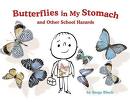 Retell: It’s the first day of school and the narrator is nervous. Each person he encounters speaks in confusing idioms.
Topics: first day of school, idioms, school
Units of Study: Personal Narrative, Realistic Fiction
Reading Skills: monitoring for sense, envisionment
My Thoughts: It’s well into August and that means that my mind is beginning to think more and more about the first weeks of school. I’m on the hunt for engaging books to start the year out well. I found this cute book a few days ago during a visit to Powell’s Books in Portland, Oregon. Butterflies in My Stomach and Other School Hazards not only makes for a good read aloud on the first day of school, but it is also great for introducing idioms. On each page the main character encounters a person who says an idiom. Each idiom is illustrated literally. For example, when his teacher said “he was all ears,” the illustration shows the teacher with giant ears. If you didn’t want to read this book aloud in one sitting, you could read a page or two each day as a warm-up activity. You could keep a chart of idioms that the class learns each day.
44. Shrek! by William Steig
 Retell: Shrek is proud to be an ugly ogre. He loves everything disgusting and enjoys scaring people around him. One day he visits a fortune teller who tells him that he is destined to meet a princess even uglier than he. With the help of a donkey he travels to the castle, defeats a knight and meets the princess of his dreams.
Topics: ogres, nightmares, monsters, fortune tellers
Units of Study: Fantasy
Reading Skills: monitoring for sense, envisionment
Writing Skills: using rhyme, including interesting vocabulary
My Thoughts: I never realized how different the original story was from the movie. The movie version has a much stronger moral more lesson but that doesn’t mean Steig’s classic does not have value as a read aloud. I think this book lends itself quite well to modeling how readers monitor for sense. Steig writes with rich vocabulary. His characters never walk, speak, or work. Rather they, stalk, hiss, and scythe. Giggle alert: the story includes the word jackass, which refers of course to the donkey in the story. Read aloud with discretion.
42. River of Dreams: The Story of the Hudson River by Hudson Talbott
 Retell: A beautifully illustrated history of the Hudson River.
Topics: Hudson River, New York, Native Americans, Henry Hudson, dreamers, Dutch, explorers, British, American Revolution, Robert Fulton, Erie Canal, trade, Hudson River School Painters, Industrial Revolution, environment, Franny Reese, pollution, immigration
Units of Study: Nonfiction, Social Issues, Content Area
Tribes: mutual respect
Reading Skills: envisionment, determining importance, questioning, synthesis
Writing Skills: including expository text features
My Thoughts: My eyes grew wide when I spotted this book in Barnes and Noble this afternoon. This book is treasure for New York 4th grade teachers who will be embarking on a year-long study of New York history. A timeline painted in the shape of the Hudson River winds throughout the book noting historic events including: the American Revolution, the commercial success of Fulton’s steamboat, the opening of the Erie Canal, and the Scenic Hudson Decision. I think I may read this book in September when we discuss what we will be learning in Social Studies this year. When we get to a new unit, I think I’ll reread corresponding sections of River of Dreams. Talbott also highlights writers and artists who were inspired by the Hudson River such as Washington Irving, James Fenimore Cooper and the Hudson River School Painters. This is a great book to use when discussing trade and industry. There is a beautiful painting in the book that shows the Hudson River bursting with steamboats and schooners–“America’s first superhighway.” I like how the story includes the environmental impact of industrial pollution and the story ends with a strong message–it’s up to us to protect the beauty of this river.
41. Shanghai Messenger by Andrea Cheng
 Retell: Xiao Mei is invited by her uncle to visit China. At first she is reluctant to travel by herself and once she arrives she finds the new setting lonely and disorienting. She eventually adjusts and begins to appreciate her extended Chinese family.
Topics: Chinese, China, poetry, family, mixed-race, language barrier, traveling, homesickness
Units of Study: Character, Personal Narrative, Social Issues
Tribes: appreciations/no put-downs
Reading Skills: interpretation, inference, envisionment, making connections
Writing Skills: incoporating foreign languages, zooming in on small moments, including sensory details
My Thoughts: I love how this story is told as a series of free verse poems. I plan on reading this book aloud when I teach how writers zoom in on small moments. Each poem is a small moment from her trip. It can be a good mentor text for writers who want to write about a vacation and are tempted to write about the entire vacation. Cheng incorporates Chinese vocabulary throughout the story. She even includes a Chinese glossary with a pronunciation guide which will aid readers when they attempt to read it aloud. It’s also a good book to read when studying character change. In the beginning, Xiao Mei is afraid to go to China by herself and thinks she will never adjust to life in China. By the end she develops into a grown-up girl who is both completely American and completely Chinese.
40. Rent Party Jazz by William Miller
 Retell: Sonny is worried. His mom just lost her job at the fish market and is worried that they may not make rent. Sonny meets the musician Smilin’ Jack who comes up with a solution that turns out to be both profitable and entertaining.
Topics: New Orleans, rent, money, jazz, parties, music, community
Units of Study: Social Issues, Historical Fiction
Tribes: personal best, attentive listening
Reading Skills: envisionment, interpretation
Writing Skills: using commas to tuck in details
My Thoughts: Great books teach us something new. Rent Party Jazz not only tells a story of Sonny and his family, but tells the story of the origin of rent parties throughout African-American communities in the South. The book will be great to read when your class needs to be reminded of the power a strong, supportive community. Even something as bleak as not being able to pay rent can be conquered when people work together.
38. Ling Cho and His Three Friends by V.J. Pacilio
 Retell: Ling Cho is a successful farmer. He feels sorry for his three friends who do not share his success. He thinks of a way to help his friends without making them feel bad. Unfortunately things do not go as planned. His friends learn that it is more wise to ask for help than to take advantage of people.
Topics: harvest, farming, China, asking for help, honesty, friendship
Units of Study: Folk Tales, Talking and Writing About Texts, Social Issues, Poetry
Tribes: mutual respect, personal best
Reading Skills: inference, interpretation, envisionment
Writing Skills: using rhyme and rhythm, incorporating alliteration
My Thoughts: This beautiful book teaches an interesting lesson on asking for help. It also seems to caution against involving friends in business matters. Ling Cho does a favor for his friends by asking them to sell his bumper crop of wheat at market. They were supposed to split the profits. However, each friend ended up keeping the profits or keeping the wheat. The story is told in rhyming verse making it an engaging read.
37. Tallchief: America’s Prima Ballerina by Maria Tallchief with Rosemary Wells
 Retell: This is an autobiographical story of Maria Tallchief, one of the greatest American-born ballerinas of her time.
Topics: native americans, Osage, Oklahoma, ballet, Westward Expansion, music, interests, biographies, narrative nonfiction
Units of Study: Social Issues, Nonfiction
Tribes: personal best
Reading Skills: inference, determining importance, envisionment
Writing Skills: seeing the world as a writer, using interesting transitional phrases
My Thoughts: This story is great to read when discussing what it means to put your all into something. Maria Tallchief lived, breathed, and ate music and dance. She writes about how her teacher told her to live like a dancer “When you sleep, you must sleep like a dancer. When you stand and wait for the bus, you must wait for the bus like a dancer.” This particular scene reminds me how we often challenge our students to live like writers. Perhaps now we can tell students, “When you wait for the bus, you must wait for the bus like a writer–notebook in hand, waiting to collect stories.”
33. The A+ Custodian by Louise Borden
 Retell: John Carillo is the custodian for Dublin Elementary School. Everyone in the school thinks he is a great custodian. A few students decide to find a way to appreciate all his hard work.
Topics: custodians, school, hard work,
Units of Study: personal essay, realistic fiction
Tribes: personal best, appreciations/no put-downs, mutual respect
Reading Skills: inference, envsionment
Writing Skills: incorporating tight lists, elaboration, including sensory details
My Thoughts: This is a fabulous book to take out when you feel the class needs to take more responsiblity picking up after themselves. The A+ Custodian reminds me that I should take more time thoughout the year to appreciate the janitors and custodians at my school. I love how the author emphasizes how much Mr. Carillo loves and is proud of the students of Dublin Elementary School. I plan to use this book when collecting ideas for personal essays. The text is a great example of the strategy, “Writers think of a person in their life and jot down ideas about him/her.” In fact the author’s note at the beginning itself makes a good mentor text for personal essay.
32. Team Moon: How 400,000 People Landed Apollo 11 on the Moon by Catherine Thimmesh
 Retell: Thimmesh tells the story of the Apollo 11 mission. It includes several quotes, interviews and amazing photographs from the moon landing.
Topics: moon landing, space, Apollo 11, teamwork, goals, problem-solving, perseverance
Units of Study: Nonfiction, Content Area, Personal Essay
Tribes: attentive listening, mutual respect, personal best
Reading Skills: envisionment, inference, interpretation, determining importance
Writing Skills: using descriptive language, inserting quotations, using dashes, using ellipses
My Thoughts: To commemorate its 40th anniversary I plan to read at least one book about the moon landing this year. What I love about this particular book is its emphasis on teamwork. As the title suggests, Apollo 11 was successful because of the dilligence of several hundred-thousand people working together in teams trying to accomplish one goal. It’s a dense book so I can see reading only a few sections at a time. This could be used as a rich mentor text for writing nonfiction. Thimmesh writes with excitement and enthusiasm making the text very engaging.
 Teachable Texts