Posts filed under ‘Picture Books’
61. The Relatives Came by Cynthia Rylant
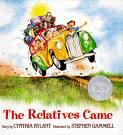 Retell: Every summer the relatives from Virginia drive several hours to visit their family. There is a lot of hugging, a lot of chatting and a lot of eating. When they leave, the house feels a bit empty.
Topics: family, summer, reunions
Units of Study: Personal Narrative, Memoir
Reading Skills: envisionment, inference, making connections
Writing Skills: using sensory details, describing how time passes
My Thoughts: I found this classic for only $2 at a great used bookstore in Mt. Shasta, California. It used to belong to a library so the bottom of each page is cracked, crinkled and reinforced with tape–a testament to how much we love this book. This is a wonderful book to use during the Personal Narrative unit. Though it’s not technically a small moment (the book spans over two weeks) sections of it can be used as a mentor text. I notice that many of my students struggle when writing about time. They often spend a lot of energy including each detail because it happened ‘next’. I see a lot of stories where each sentence begins with ‘then’. Sections of The Relatives Came could be used to show how authors deal with time. The relatives drive for a long time but Rylant doesn’t describe every single thing they see or every pit stop they make. She chooses to focus on a few details only, the strange houses, mountains, and their thoughts of purple grapes back home. The illustrations also tell a story themselves making it a good book for modeling inference.
60. In My Momma’s Kitchen by Jerdine Nolen
 Retell: This is a heartwarming collection of small moments that all take place in a family’s kitchen: a daughter receives a music scholarship, children make up stories, women chitchat and a father makes his signature dish.
Topics: family, community, childhood
Units of Study: Personal Narrative, Memoir
Tribes: mutual respect
Reading Skills: monitoring for sense, envisionment, interpretation
Writing Skills: zooming in on small moments
My Thoughts: This is a great text to read at different points of the year. I originally purchased this book thinking it would be a good read aloud for the Personal Narrative unit. After reading it a second time, I realize that it’s also a great mentor text for the Memoir unit. Each story is connected by its setting–the kitchen. Using this text students could try out Nolen’s strategy of thinking of an important place (a room, a park) and write memories associated with that place. Since this book reads like an anthology of notebook entries, you could use this text when introducing the writer’s notebook.
59. My Ol’ Man by Patricia Polacco
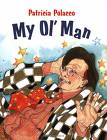 Retell: When she was growing up, Patricia Polacco spent the summers with her father and her grandmother. In this charming book, Polacco tells the story of the time they found a magical rock that helped them cope with hard times.
Topics: divorce, summer, dads, grandmothers, storytelling, layoffs, magic
Units of Study: Personal Narrative, Memoir
Tribes: attentive listening
Habits of Mind: responding with wonderment and awe
Reading Skills: prediction, monitoring for sense
Writing Skills: using commas in lists, crafting meaningful introductions
My Thoughts: Patricia Polacco is one of my favorite authors and I often read several of her books during the Personal Narrative unit. Most of her books are inspired by moments, people, and places in her life. In the beginning of My Ol’ Man, there are authentic photographs from Polacco’s childhood. This book would be great to read as you are teaching how writers use artifacts to generate notebook entries. When writing about people, my students often make lists of what they like about a person. This book will be great to use as a mentor text to help students move from list writing (“My dad likes tacos. My dad takes me places.) to narrative writing (“One time my dad brought out this book of stamps. I’ll never forget the time when my dad took me for a ride in his 1947 GMC truck.”)
57. The Dot by Peter H. Reynolds
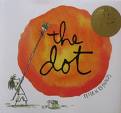
Retell: Vashti is frustrated in art class. She doesn’t have confidence in her artistic ability. Her teacher tells her to start with a dot and see where it takes her. Soon she experiments with dots of different colors, shapes and sizes and becomes pleased with the results.
Topics: art, writer’s block, creativity, experimentation
Units of Study: Personal Narrative
Tribes: personal best, appreciations/no put-downs, mutual respect
Habits of Mind: persisting, creating-imagining-innovating, responding with wonderment and awe, taking responsible risks, thinking interdependently
Writing Skills: dealing with writer’s block, revising
My Thoughts: Though this book is about art, readers will make the obvious connection to writing. I love the message of this book—experiment and enjoy the process. If I don’t read this out loud to my entire class, I will definitely use this in small group work to help struggling writers get over their fear of the blank page. I like how at the end of the book Vashti helps another young artist get over his frustration. It’s a good example of how learners help one another.
56. What Joe Saw by Anna Grossnickle Hines
 Retell: Joe is always lagging behind the class. His teacher and his classmates are always telling him to hurry up. It’s not until a classmate stops to tie his shoes that he realizes why Joe keeps falling behind.
Topics: school, field trips, discovery, curiosity
Units of Study: Realistic Fiction, Talking and Writing about Texts
Tribes: appreciations/no put-downs, mutual respect
Habits of Mind: responding with wonderment and awe
Reading Skills: interpretation, inference
Writing Skills: using repetition, dialogue
My Thoughts: The main character in this book reminds me of my sweetheart. When we’re on route somewhere he always stops to smell the flowers on butterfly bushes or picks fruit from trees. If I’m in a hurry it can be frustrating at first, but most of the time it’s worth it to be a few minutes late. I appreciate how he makes me slow down and notice the world around me. What Joe Saw is a good book to read when you want your class to discuss the importance of paying attention to small details. However, you may not want to read this book to your class just before going on a field trip. It may be good to read during an interpretation unit. I can imagine having interesting discussions about the individual vs. the group.
55. The Bumblebee Queen by April Pulley Sayre
 Retell: This book describes the life cycle of a bumblebee queen.
Topics: bumblebees, life cycles, habitats, pollination
Units of Study: Nonfiction, Content Area Reading and Writing
Reading Skills: envisionment, questioning, determining importance
Writing Skills: using commas to separate clauses
My Thoughts: I like how this book is structured. It has two threads–a narrative thread and an expository thread. In bold letters the text tells a story about the amazing work of a bumblebee queen. On every other page or so there are fact bubbles that give more detailed information about bumblebees. I plan on using this book when we do our Content Area unit which will focus on life cycles and habitats.
54. Two Bobbies: A True Story of Hurricane Katrina, Friendship, and Survival by Kirby Larson and Mary Nethery
 Retell: This is the true story of how a stranded cat and dog survived the aftermath of Hurricane Katrina.
Topics: pets, Hurricane Katrina, survival, friendship, family, homelessness
Units of Study: Social Issues, Nonfiction, Talking and Writing about Texts
Tribes: personal best, mutual respect
Habits of Mind: taking responsible risks, thinking flexibly
Reading Skills: envisionment, inference, interpretation
My Thoughts: This is a book that I didn’t mind buying brand new and in hardcover. I found this in a bookstore in Ashland, Oregon. The cashier and I spent a few moments cooing over her ridiculously cute it is. In addition to being an amazingly touching story it’s a great text to read to learn about Hurricane Katrina. It could also be a great read aloud during an interpretation unit. On one level it’s a story about survival but it could also be interpreted as a story about friendship between two individuals who come from groups who are normally not friendly to each other.
53. Dogzilla by Dav Pilkey
 Retell: Every year the mice in Mousopolis have an annual barbecue cook-off. The festivities were interrupted one year when the aroma from the cook-off awoke Dogzilla. The mice band together and eventually defeat Dogzilla by attacking him with a mighty weapon–a dog bath.
Topics: dogs, mice, teamwork
Units of Study: Fantasy
Tribes: personal best
Habits of Mind: persisting, thinking flexibly, thinking interdependently, applying past knowledge
Writing Skills: using dashes, using transitional phrases
My Thoughts: I’ve read this book about five times this summer and each time I read it I giggle to myself. What makes this a fun and engaging read aloud are the illustrations. Pilkey created characters out of his pet mice and pet Corgie. I love how the ferocious monster in the story is a cute cuddly dog who looks so happy in each picture. I think it will be a good read aloud for introducing Habits of Mind. When finding a way to beat Dogzilla they ‘persist,’ ‘think flexibly and interdependently’ and ‘apply past knowledge.’ This may also be a good mentor text for students writing fantasy stories. Students could try generating story ideas by doing what Dav Pilkey did and cast one’s pets as characters in a fantasy story.
52. Night of the Gargoyles by Eve Bunting
 Retell: During the day gargoyles suffer a lot of abuse. They get rained on, they endure the heat and they tolerate nasty pigeons. However, during the evening the gargoyles come out to play.
Topics: gargoyles, play, perspectives, night
Units of Study: Fantasy
Reading Skills: envisionment, monitoring for sense
Writing Skills: using descriptive language, incorporating interesting vocabulary
My Thoughts: I never realized how much I love the works of Eve Bunting. This is the third book of hers that I’ve reviewed. Night of the Gargoyles might be a nice book to read on or prior to Halloween. It’s spooky but not too creepy. It’s also a good book for introducing the idea that there are different perspectives other than our own. A lot of writers have created fabulous stories by considering the perspective of animals, objects, insects, etc. (ex. James and the Giant Peach, Charlotte’s Web). This could then lead to a discussion about using personification in our writing.
49. Fireflies in the Dark: The Story of Friedl Dicker-Brandeis and the Children of Terezin by Susan Goldman Rubin
 Retell: Learn about the amazing life of Friedl Dicker-Brandeis, who taught art to children in the Terezin Camp during the Holocaust. The book includes several photos, drawings, paintings and writings from her students, many of whom did not survive.
Topics: art, holocaust, ghetto, Terezin, Nazis, school, poetry, drama, resiliency
Units of Study: Personal Narrative, Nonfiction, Content Area Reading and Writing, Social Issues
Tribes: personal best, mutual respect
Habits of Mind: persisting, thinking flexibly, creating-imagining-innovating, thinking interdependently, remaining open to continuous learning
Reading Skills: envisionment, determining importance, interpretation, inference
Writing Skills: launching writers notebook, zooming in on small moments
My Thoughts: One can learn many lessons from this book. I am impressed by Dicker-Brandeis’ devotion to learning. When she discovered that she would be sent to Terezin she chose not to bring items for herself, but art supplies for the children she knew would be in the camp. Through art her students were able to both escape and record the horrors around them. Though I don’t plan on teaching a unit about the Holocaust this year, I may choose to read a portion of this book when emphasizing how writers notebooks can be powerful places to record our memories, our thoughts and our struggles. It is important for our students to realize that their experiences, just like those recorded at Terezin, are important and should be recorded.
 Teachable Texts