Posts filed under ‘Picture Books’
12. Families are Different by Nina Pellegrini
 Retell: Nico is an adopted girl from Korea who begins to feel different from her friends because she doesn’t resemble her parents. After closer observation, Nico realizes that there are many different types of families.
Topics: adoption, divorce, families
Units of Study: memoir, personal narrative, social issues
Tribes: appreciations/no putdowns (appreciating our loved ones), mutual respect
Reading Skills: making connections
Writing Skills: developing the heart of a story
My Thoughts: Do not expect subtlety when reading this book. The title hits you over the head with the book’s message. I can’t imagine using this book for higher level reading work. However, I think it could be a good mentor text when teaching writers to revise by developing the heart of a story. Families are Different is written in a style similar to some of the notebook entries my students tend to write: “Hello, my name is______. I live in ______. I’m going to tell you all about my friends.” Halfway through the story, however the narrator begins to reveal some of her thoughts and emotions about being adopted. I can see reading this story and asking students to identify when the author started getting to the heart of the story. I would also read this during a community circle to encourage discussion about respecting differences.
11. The Whingdingdilly by Bill Peet
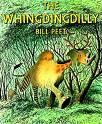 Retell: Scamp is tired of being a dog and wishes he was a grand horse. He runs away and encounters a witch who turns him into a creature called the Whingdingdilly.
Topics: dogs, witches
Units of Study: Fantasy, Character
Tribes: Appreciations/No Putdowns
Reading Skills: inference, prediction, making connections
Writing Skills: using a balance of description and dialogue, using interesting verbs
My Thoughts: I really felt for Scamp in the beginning of this book. I’m a sucker for dogs who are down in the dumps. Unfortunately Scamp’s owner, Orvie calls him a “silly old dog” when he catches his dog pretending to be a horse. Though calling someone ‘silly’ may not be the worst putdown heard at school, I can still see using this book as a way to discuss the damage brought about by insults and putdowns. Scamp begins to feel better, and his luck begins to change when he hears how much Orvie appreciates him. The Whingdingdilly also teaches the importance of appreciating ourselves for our strengths rather than putting ourselves down for our faults. This could also be used as a mentor text during a unit on Fantasy writing. The story has a few fantastical elements but is mostly based on reality.
10. Come On, Rain! by Karen Hesse
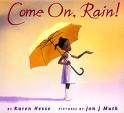 Retell: A young girl anticipates the long awaited thunderstorms that will cool down the humid city she lives in.
Topics: heat, rain, family, summer, cities, thunderstorms
Units of Study: personal narrative, poetry
Reading Skills: envisionment, making connections
Writing Skills: including similes, using active verbs, personification, alliteration
My Thoughts: This book makes me wish it was more humid outside right now. Every New Yorker without air conditioning will be able to relate to this book. I love how Hesse uses poetic devices throughout this small moment story, making it a nice mentor text for personal narrative or poetry unit. She includes personification: “The smell of hot tar and garbage bullies the air…” There is alliteration and assonance: “The first drops plop down big, making dust dance all around us.” Hesse teaches young writers to slow down and zoom in on ordinary moments.
9. Dogteam by Gary Paulsen
 Retell: A moonlit night inspires the narrator to take his dogs on an exciting night ride.
Topics: dogs, dog sledding
Units of Study: personal narrative, content-area writing
Reading Skills: envisionment
Writing Skills: using active verbs, zooming in on a small moment, incorporating sensory details, adding suspense, inserting commas and semicolons, repetition
My Thoughts: Dogteam reads more like prose. In addition to including beautiful imagery, Paulsen’s book has many examples of how writers use all senses to describe a moment in time. Though I would categorize this as a personal narrative, one could also use this as a mentor text for writing nonfiction poetry.
8. The Lucky Star by Judy Young
 Retell: Ruth, a young girl growing up during The Great Depression, discovers that her school will be closed down before she enters her 5th grade year. Ruth learns a lesson of perseverance and counting one’s lucky stars.
Topics: The Great Depression, perseverance, family,
Unit of Study: Historical Fiction, Character
Tribes: Personal best
Reading Skills: inference, making connections, prediction
Writing Skills: incorporating setting details, using sensory details
My Thoughts: This book would be a great mentor text during a unit on reading and writing historical fiction. However, I’m tempted to use this at the beginning of the year when I introduce partner work and independence. The Lucky Star teaches that smart people persevere through difficult situations. A closure of a school, or similarly an absence of a teacher or a change in schedule, does not mean that learning stops completely.
6. The Wall by Eve Bunting
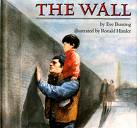 Retell: A father and son visit the Vietnam Memorial in Washington D.C. The young son describes what he sees and hears on the day of his visit.
Topics: family, Memorial Day, Vietnam War
Units of Study: Personal Narrative, Social Issues
Tribes: Mutual Respect, Right to Pass
Reading Skills: inference, synthesis
Writing Skills: writing sensory details, writing small moments
My Thoughts: The Wall is one of those books that may be difficult to read aloud with a dry eye. I can see reading this book duing the beginning of the year during the Personal Narrative unit and then rereading it during the Social Issues unit. I could even reread it yet again right before Memorial Day. The Wall provides a good example of how a writer can zoom in on a small moment. The entire book takes place in one location and does not span more than a few hours. Each line of the book encourages readers to question and infer: “That couple seems like they’ve lost someone. Who did they lose?” You could also reread this book with a Tribes lens. You could encourage your students to discuss how the boy solved a problem, not by yelling at the crowd of noisy school girls, but by standing next to his reverent father, supporting his moment of silence in a show of solidarity.
5. The Girl Who Lost Her Smile by Karim Alrawi
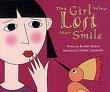 Retell: One day in Baghdad a girl named Jehan loses her smile. Her father searches the world for someone who will help his daughter find her smile.
Topics: Baghdad, art, folk tales
Units of Study: Fantasy, Creating Community, Geography
Tribes: Personal Best, Mutual Respect
Reading Skills: envisionment, making connections, prediction
My Thoughts: This is a very quick read aloud which could be good for discussing the expectation of doing one’s personal best and the satisfaction it brings. Throughout the book Jehan’s father brings her the most beautiful art in the world to cheer her up. However, it is not until she participates in the arduous process of making a wall gleam that she finally finds her smile. It woule be nice to use this as a community building mentor text. We can discuss how Jehan’s family did their best to cheer her up and how we should try and give our friends encouragement and help them find their smiles when they are down. Her father brings art from around the world to cheer her up. I could see asking students to find those places on a world map to practice their geography skills.
4. Neeny Coming, Neeny Going by Karen English
 Retell: Neeny and her cousin were raised on Daufuskie Island, located off the coast of South Carolina. Years before, Neeny went back to the mainland to live with her mother. When Neeny returns to the island, her cousin realizes that Neeny is not the same cousin she grew up with.
Topics: change, family, environmental issues
Units of Study: Social Issues, Character
Tribes: mutual respect
Reading Skills: envisionment, prediction, inference, monitoring for sense, interpretation, making connections
Writing Skills: writing with voice
My Thoughts: This is a great book for the Social Issues unit. I can imagine a juicy discussion about how much the mainland changed Neeny. Many of my students travel back to their home countries during vacation. I think they could make a lot of connections to this book. I can see using this book as a mentor text for showing how authors write with a distinctive voice.
3. Uptown by Bryan Collier
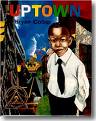 Retell: A young boy writes about his observations of Harlem.
Topics: neighborhoods, Harlem, community
Units of Study: Personal Narratives, Geography of New York
Reading Skills: envisionment
Writing Skills: writing small moments, including setting details, writing metaphors and similes
My Thoughts: This beautiful book shows that writers observe the world around them. Each observation is something that can turn into powerful writing. I plan on using this book as a mentor text for teaching about metaphors and similes. Collier writes, “Uptown is a caterpillar. Well, it’s really the Metro-North train as it eases over the Harlem River.” Though my students don’t live in Harlem, I’m hoping that reading this book together will show them that they need to share their world with others through writing. The world needs more books about Sunset Park, Brooklyn! For 4th grade teachers in New York, I can see using this book during a Geography unit. Perhaps after reading Uptown, students could locate the landmarks in the book on a subway map.
2. Three Days on a River In a Red Canoe by Vera B. Williams
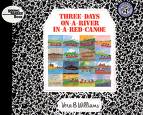
Retell: After purchasing a red canoe at a yard sale, a family goes on a three-day canoe trip.
Topics: Family, adventure, camping
Units of Study: Personal Narratives, Launching the Writers Notebook
Tribes: Personal Best
Reading Skills: envisionment, making connections, inference
Writing Skills: incorporating details about setting, using transition words, including sensory details, writing endings that connect to the beginning
My thoughts: This book has great teaching potential. As the marbled cover suggests it reads like someone’s writers notebook. Each page describes a scene from the camping trip. I can imagine using this book when I introduce writers notebooks to my students. Each page is a small moment that could be stretched into a larger story. The colorful, colored pencil drawings will be inspiring for young artists who like to draw pictures with each notebook entry. I plan on using this as a mentor text for students who want to write endings that connect to an earlier scene.
 Teachable Texts