Posts filed under ‘Male authors’
85. Kat Kong by Dav Pilkey
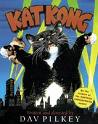 Retell: Explorers from Mousopolis land on an uncharted island where they meet the terrifying “beast” Kat Kong. They bring him back to Mousopolis in order to seek fame and fortune. When Kat Kong escapes his shackles, citizens are terrified.
Topics: cats, mice, greed, exploration, monsters, humor, puns
Units of Study: Fantasy
Tribes: mutual respect
Habits of Mind: finding humor
Reading Skills: monitoring for sense
My Thoughts: This is the adorable sequel to Pilkey’s book, Dogzilla. Similar to the style of Dogzilla, Kat Kong includes ‘cheesy’ puns and idioms, all related to cats. For example, when Kat Kong ravages the city the butcher cries, “The cat’s got my tongue!” I plan to read this book aloud when I want to focus on the reading skill monitoring for sense. I find that many books written for upper elementary students are highly engaging, but can also be really confusing. Many of my students are English Language Learners and often don’t understand when an author slips in a joke. Using Kat Kong as an a model could remind students to seek out humor throughout their reading.
82. Flying Over Brooklyn by Myron Uhlberg
 Retell: On a snowy, winter’s evening a boy dreams of flying over Brooklyn. He visits many of his favorite places: Prospect Park, The Brooklyn Bridge and of course, Coney Island.
Topics: Brooklyn, birds-eye view, dreams, flying, imagination, winter
Units of Study: Personal Narrative, Memoir
Habits of Mind: responding with wonderment and awe
Reading skills: envisionment, making connections
Writing Skills: using sensory details, using observation to generate entries, zooming in on small moments
My Thoughts: This book is beautifully written. I think it will be an excellent book to use as a mentor text for using descriptive language. When I read this aloud, I plan on pointing out how the author makes you feel the snow and sense the quiet throughout the snowy city. 4th grade teachers in New York may want to read this during a Geography unit. After reading the book aloud, students could find each place on a map or make their own map based on places visited throughout the text.
80. Three Samurai Cats: A Story From Japan by Eric A. Kimmel
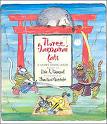 Retell: Many years ago, in a castle in Ancient Japan, there lived a powerful lord with a terrible rat problem. He tried everything in his power to chase the rat away, but the rat would not leave. He asked the senior monk to send his strongest samurais to defeat the rat. Both of them were thwarted. Finally, the senior monk sent his oldest and wisest samurai to the castle. He beat the rat with his ultimate weapon–patience.
Units of Study: Talking and Writing About Texts
Topics: Japan, rats, power, patience, samurais, monks, bullies
Habits of Mind: persisting, thinking flexibly, managing impulsivity
Reading Skills: monitoring for sense, interpretation
Writing Skills: incorporating the rule of three
Thoughts: When I read this book I immediately thought of those situations where we want to fight back. When someone insults us we want to think of a better insult to ‘squash’ that person. How often do we see students try and assert power over another with a put-down, a push, a punch? This book is great for discussing how bullies are truly defeated.
73. David Goes to School by David Shannon
 Retell: David is a rambunctious boy who wreaks havoc at school. After coloring on the desks he stays in after school to clean them up.
Topics: school, rules, behavior, bathroom, calling out
Units of Study: Personal Narrative
Tribes: mutual respect, attentive listening, personal best
Writing Skills: using memories to generate notebook entries
Thoughts: Here is a just-for-fun read aloud for the first day of school. It’s a great read for beginning a discussion about rules, agreements and norms. If you have access to Guys Read you may want to share David Shannon’s story about how he created the David books. The anthology has cool original pictures of the young version of his other book No, David!
72. Love You Forever by Robert Munsch
 Retell: A mother starts a tradition of singing a song to her son: “I’ll love you forever, I’ll like you for always, As long as I’m living my baby you’ll be.” Through the terrible twos, adolescence and adulthood the mother sings this song to her child. When the mother becomes old and sick, it is the son’s turn to sing the song.
Topics: family, childhood, parenting
Units of Study: Personal Narrative, Memoir
Tribes: mutual respect
Reading Skills: making connections, prediction
Writing Skills: using traditions and special moments in your life to create a story
Thoughts: I just got back from my friend’s baby shower. I’m kicking myself for not adding this book to her other gifts. This is a book that is sure to make the reader teary-eyed. If you are strong enough to read it in front of your class, it could be a great mentor text for generating ideas for personal narratives or memoirs. This book could inspire young authors to think and write about the traditions, the songs, or customs important to their own families.
64. What a Day it Was at School! by Jack Prelutsky
 Retell: A collection of silly school poems on topics such as: homework, field trips and farting.
Topics: school, homework, field trips, libraries, food chain, history, poetry, partnerships
Units of Study: Fantasy, Authoring an Independent Reading Life
Tribes: mutual respect
Habits of Mind: responding with wonderment and awe
Writing Skills: incorporating rhythm and rhyme
My Thoughts: The poems in this collection are very, very silly–perfect for those ‘just for fun’ read alouds I mentioned yesterday. I think I’ll read, “I Made a Noise This Morning” (a poem about a student farting in class) when my students need a quick laugh. Though this collection is probably more suitable for younger grades, a few of the poems could be good hooks for mini-lessons or project launches. I’m planning on sending home more independent project ideas in Science and Writing. When I launch this project I may read Prelutsky’s “Homework” which describes a gooey experiment that didn’t go as planned. There is a cute poem entitled, “A Classmate Named Tim,” that I think I’ll use when introducing partnerships.
62. “Before New York” by Peter Miller, National Geographic September 2009
 Retell: Peter Miller investigates the Mannahatta Project, a group who have analyzed several historical maps in order to create pictures of what Manhattan might have looked like when Henry Hudson spotted the island back in 1609.
Topics: New York, beavers, then & now, New Amsterdam, Hudson, conservation, geography, maps
Units of Study: Nonfiction, Content Area
Habits of Mind: thinking interdependently, responding with wonderment and awe, striving for accuracy
Reading Skills: envisionment, determining importance, questioning
My Thoughts: My eyes lit up when I received my monthly National Geographic magazine yesterday afternoon. The feature article, “Before New York,” is dedicated to presenting a picture of the landscape of New York City before it was the crowded, bustling town it is today. If you are a 4th grade teacher in New York I highly recommend going out to your local news stand and picking up a copy today. The article includes several pictures of ‘then and now’ maps and digital renderings. I plan on reading this article (or a portion of it) when we do our unit on New York geography. The article highlights how cartographers pose questions, strive for accuracy and work in groups. I may just reread the beginning of the article where the author tells the story of a beaver named Jose who appeared near the Bronx zoo. According to the article beaver haven’t been spotted in New York City in over 200 years. If you don’t have a subscription check out the National Geographic website. If you have a projector in your classroom you could share the interactive maps of New York after reading the article.
57. The Dot by Peter H. Reynolds
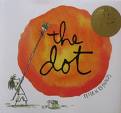
Retell: Vashti is frustrated in art class. She doesn’t have confidence in her artistic ability. Her teacher tells her to start with a dot and see where it takes her. Soon she experiments with dots of different colors, shapes and sizes and becomes pleased with the results.
Topics: art, writer’s block, creativity, experimentation
Units of Study: Personal Narrative
Tribes: personal best, appreciations/no put-downs, mutual respect
Habits of Mind: persisting, creating-imagining-innovating, responding with wonderment and awe, taking responsible risks, thinking interdependently
Writing Skills: dealing with writer’s block, revising
My Thoughts: Though this book is about art, readers will make the obvious connection to writing. I love the message of this book—experiment and enjoy the process. If I don’t read this out loud to my entire class, I will definitely use this in small group work to help struggling writers get over their fear of the blank page. I like how at the end of the book Vashti helps another young artist get over his frustration. It’s a good example of how learners help one another.
53. Dogzilla by Dav Pilkey
 Retell: Every year the mice in Mousopolis have an annual barbecue cook-off. The festivities were interrupted one year when the aroma from the cook-off awoke Dogzilla. The mice band together and eventually defeat Dogzilla by attacking him with a mighty weapon–a dog bath.
Topics: dogs, mice, teamwork
Units of Study: Fantasy
Tribes: personal best
Habits of Mind: persisting, thinking flexibly, thinking interdependently, applying past knowledge
Writing Skills: using dashes, using transitional phrases
My Thoughts: I’ve read this book about five times this summer and each time I read it I giggle to myself. What makes this a fun and engaging read aloud are the illustrations. Pilkey created characters out of his pet mice and pet Corgie. I love how the ferocious monster in the story is a cute cuddly dog who looks so happy in each picture. I think it will be a good read aloud for introducing Habits of Mind. When finding a way to beat Dogzilla they ‘persist,’ ‘think flexibly and interdependently’ and ‘apply past knowledge.’ This may also be a good mentor text for students writing fantasy stories. Students could try generating story ideas by doing what Dav Pilkey did and cast one’s pets as characters in a fantasy story.
47. The House That Crack Built by Clark Taylor
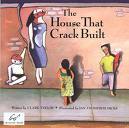 Retell: A serious poem, told in cumulative verse, detailing the many lives affected by crack.
Topics: crack, drug abuse, responsibility
Units of Study: Social Issues
Tribes: right to pass
Reading Skills: interpretation, inference, questioning, making connections
Writing Skills: using rhythm and rhyme
My Thoughts: This is an intense book. I’m trying to decide if I will read it aloud to my students this year or not. On one hand I think it’s important to have realistic discussions about drugs with elementary school students, but on the other hand I have to be aware that this book may be too heavy for some students. If I do decide to read it aloud this year I think it could be a great for the Social Issues unit. Chronicle Books has a great reading guide for the book which provides questions appropriate for both elementary and middle school aged children.
 Teachable Texts