Posts filed under ‘Female Authors’
121. Vote! by Eileen Christelow
 Retell: This book combines narrative and non-narrative text to describe how and why people vote.
Topics: voting, majority, mayors, elections, democracy, voting age, protests, marches, political parties, media, campaigns, taxes
Units of Study: Nonfiction, Content-Area
Reading Skills: monitoring for sense, determining importance, synthesis, making connections
My Thoughts: Tomorrow is election day. My students have the day off and they have no idea why. Unlike last year’s election day, the buzz around tomorrow’s election is quiet. Nevertheless, days off from school can be good teaching moments and a great time to tuck in a read aloud. Vote provides a nice, kid-friendly introduction to the world of voting. The text in the white space explains how voting works. Within the illustrations, speech and thought bubbles support a narrative thread: Chris Smith is running against Bill Brown for mayor and Smith’s family (including the family dog) all participate in the campaign. You may choose to read all of the non-narrative text and then pick and choose which speech bubbles are the most important to highlight.
If you choose to read this book (or others about voting) please add your comments in the space below.
118. Hawk, I’m Your Brother by Byrd Baylor
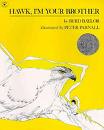 Retell: Rudy Soto yearns to fly. He climbs up a cliff and captures a young hawk in the hope that he will be able to become brothers with the hawk and thus have a sense of what it means to fly. Eventually he sets the hawk free and is forever changed.
Topics: hawks, dreams, flying, keeping pets, freedom
Units of Study: Talking and Writing About Texts, Social Issues
Tribes: mutual respect
Reading Skills: questioning, inference, interpretation, synthesis
Writing Skills: using alliteration
My Thoughts: Each year the issue of whether or not to get a class pet comes up. I have mixed feelings about class pets. I think they can be very useful for studying life cycles and animal habitats, but I don’t like the idea of animals in cages. I may read this book the next time the issue arises in my classroom. It will be an essential text during the interpretation unit and could also be an interesting one to read or reread during Social Issues.
When I was looking for images of this book I came across a website with a fantastic resource. Through the Magic Door is an online bookstore that has put together some fabulous lists of books that may be very useful when making text sets. Hawk, I’m Your Brother can be found under the list of books that are all about Flying.
117. Alfred Nobel: The Man Behind the Peace Prize by Kathy-Jo Wargin
 Topics: Alfred Nobel, Nobel Peace Prize, nitroglycerin, death, literature, art, dynamite, peace, legacy
Units of Study: Nonfiction, Content-Area
Habits of Mind: persisting, gathering data through all senses, striving for accuracy and precision, questioning and posing problems, applying past knowledge to new situations
Reading Skills: prediction, synthesis, determining importance, interpretation, empathy
My Thoughts: With the announcement of this year’s Nobel Peace Prize being awarded to Barack Obama, you may want to take the opportunity to discuss the history of the prize itself. It’s a great text for discussing the Habits of Mind. The illustrations are quite large and are particularly vivid–perfect for classroom read alouds.
114. The Gold Coin by Alma Flor Ada
 Retell: A thief discovers a woman who claims to be the “richest person in the world.” He ransacks her hut but fails to find her gold. He goes on a quest to find the woman and her gold. What he finds instead are people who teach him that being rich has little to do with gold.
Topics: gold, greed, thieves, kindness, hard work, acceptance
Units of Study: Character, Social Issues, Talking and Writing about Texts
Tribes: mutual respect
Reading Skills: prediction, interpretation, inference, empathy
Writing Skills: incorporating the rule of three
My Thoughts: I first discovered this story when I went to a Great Books training years ago. I’ve since used it a few times during the Character unit. It is a great text for examining how people can change because of their relationships with other people. It’s a great text to use when you are launching whole class conversation during and after read alouds.
112. Allie’s Basketball Dream by Barbara E. Barber
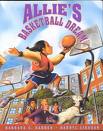 Retell: Allie wants to be a star basketball player like her cousin Gwen. After receiving a brand-new basketball from her father, she gives it a test run at the neighborhood playground. She soon finds out that not everyone is willing to accept a girl on the court.
Topics: basketball, gender issues, friendship
Units of Study: Character, Social Issues, Talking and Writing About Texts, Realistic Fiction
Tribes: mutual respect, personal best, right to pass
Habits of Mind: persisting
Reading Skills: inference, interpretation, making connections
Writing Skills: planning a story across 2-3 scenes
My Thoughts: This book is a great read aloud for so many different units. It’s a particularly good text to read during the Social Issues unit. It’s nice to read this book before or after reading other books that deal with gender issues such as, William’s Doll, or Oliver Button is a Sissy. It’s a good mentor text for the Realistic Fiction unit because the story takes place across two scenes.
110. Peppe the Lamplighter by Elisa Bartone
 Retell: Peppe and his family live in a tenement on Mulberry Street. Though he is just a boy, he must find work to help support his family. After several attempts, he finally finds a job as a lamplighter. His Papa imagines a better world for him in America. He becomes upset with Peppe for taking such a menial job. Though he loves his job, Peppe decides to take a break from it one evening in an effort to please his father. Later that evening both Peppe and his father discover that being the lamplighter isn’t such a bad deal after all
Topics: tenements, New York, child labor, lamplighters, family, perspectives, work
Units of Study: Historical Fiction, Social Issues, Talking and Writing about Texts
Tribes: appreciations/no put-downs
Reading Skills: inference, envisionment, interpretation
Writing Skills: using the ‘rule of three’, angling a story
My Thoughts: What I love about this text, is that it’s short, but inspires the reader to do a lot of good thinking. It’s a fabulous text for Reading and Writing Workshop as well as Social Studies. Using the illustrations, students can envision what New York tenement life was like during the 1800s. Though my students are currently writing Realistic Fiction, I’m planning on reading a section of this book tomorrow to a small group of students. I’m going to teach them how authors often incorporate the ‘rule of three’ when crafting stories (“The Three Little Pigs”, “Goldilocks and the Three Bears”). In the beginning of the story, Peppe attempts to find a job. The author could have chosen to describe the effort in a figurative way. Instead, she decided to give three examples of where he looked for work: the butcher, the bar, and the candy maker.
109. Encounter by Jane Yolen
 Retell: An account of Columbus’ ‘discovery’ of the Americas told from the point of view of a Taino boy.
Topics: Christopher Columbus, explorers, gold, Taino, trade, slaves
Units of Study: Nonfiction, Historical Fiction, Content-Area
Tribes: mutual respect
Reading Skills: interpretation, envisionment, inference
Writing Skills: using figurative language
My Thoughts: Yesterday was Columbus Day and to celebrate, here is one of my favorite Columbus Day read alouds. Since the story is told from the perspective of a child, students will be able to relate to how powerless the boy feels. He warns his people not to trust the “strange creatures” that were “spat out of the canoes”, but no one listens to him. This is a fantastic text for teaching inference. Yolen takes great care not to use terms that would have been foreign to the Taino people. Readers must constantly infer what the boy is describing. For example, Yolen describes beards as “hair growing like bushes on their chins”. When Columbus claims the island for Spain she describes how people “knelt before their chief and pushed sticks into the sand”. It’s important to model how readers constantly consult the illustration while reading the text in order to construct meaning.
108. Who Eats What? Food Chains and Food Webs by Patricia Lauber
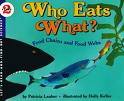 Retell: This book explains how energy flows within food chains and food webs. It also describes the importance of plant life.
Topics: food chains, food webs, interconnectedness, plants, animals, endangered species, ecology
Units of Study: Nonfiction, Content-Area
Reading Skills: envisionment, determining importance, interpretation, reading text features
Writing Skills: including diagrams to illustrate an idea
My Thoughts: Though our food chain unit is a few months away, I’m on the search for future read alouds. This is a great, straight-forward text for introducing food chains and food webs. I like the diagrams throughout the text. This would be a great text to read to introduce the idea of a diagram. After reading the text aloud, students could make food webs of their breakfast or lunch that day.
105. Twenty-Odd Ducks: Why, Every Punctuation Mark Counts! by Lynne Truss
 Retell: Lynne Truss presents illustrated examples of how the meaning of a sentence changes when a writer makes poor choices about punctuation.
Topics: punctuation
Units of Study: Any Writing unit
Tribes: personal best
Habits of Mind: thinking and communicating with clarity and precision
My Thoughts: This is the companion to her book, Eats, Shoots and Leaves. This book, however doesn’t just focus on commas. When students started to edit their personal narratives during our last Writing unit, I taught a lesson about how writers make important choices about end punctuation (for more fabulous lessons about teaching grammar and punctuation consult The Power of Grammar). I plan on reading this book in a few weeks when I review this concept with students. I hope this inspires students to experiment with punctuation.
101. Heartland by Diane Siebert
 Retell: A celebration of the Midwest, told in rhyming verse and gorgeous illustrations.
Topics: rural communities, landforms, plains, farming
Units of Study: Nonfiction, Content-Area
Habits of Mind: responding with wonderment and awe
Reading Skills: monitoring for sense, envisionment
Writing Skills: creating metaphors, personification
My Thoughts: At the moment my class is learning how readers interpret maps. They have difficulty envisioning what places look like. In their minds, New York State is just one gigantic city. I plan on reading this book aloud to help my ‘citified’ students envision what rural areas look, feel and sound like. It will be great to use this as a mentor text in a few months during the Content-Area unit when some students may choose to write nonfiction poetry.
 Teachable Texts